

Friday, May 31, 2013

Thursday, May 30, 2013
Our End-of-the-Year Party
Thanks to Debra Surrency for planning an outstanding time for our kids. Thanks to our other fabulous moms who sent in food and helped with the games. We couldn't do it without you! Check out the videos for some laughs!
Monday, May 20, 2013
Volume Project

Thursday, May 16, 2013
Math Challenge Area and Perimeter
A fence encloses a rectangular garden that is 50 feet long and 10 feet wide. To make the garden larger while using the same fence, its shape is changed to a square. By how many square feet does this shape enlarge the garden?


Friday, May 10, 2013
Join us for Spirit Week!
Join Us and Have Fun!
Monday- Pajama day
Tuesday- Career day
Wednesday- Sport Team day
Thursday- Superhero day
Friday- Eco day
-Riley
Monday- Pajama day
Tuesday- Career day
Wednesday- Sport Team day
Thursday- Superhero day
Friday- Eco day
-Riley
Tuesday, May 7, 2013


Thursday, May 2, 2013
9.8 Challenge-Multiplying with Fractions and Decimals

When the students in Mrs. Andersen’s class arrive at the Science Museum, Kara is very excited to learn that there is a dinosaur exhibit. In fact, it is a famous dinosaur exhibit. A set of dinosaur bones from a triceratops has been reconstructed and is on display. Kara can’t wait to get to see it. She has a feeling that this is going to be her favorite part of the museum. Several other students are equally excited, so Mrs. Andersen and the chaperones decide to go to the exhibit first and the split up into groups. When Kara walks in, she is delighted. There before her eyes is a huge skeleton of a triceratops. After visiting the exhibit for a while, the students begin to move on. Mrs. Andersen sees Kara hesitate before leaving the exhibit. She walks over to her.
“Imagine, that dinosaur is about 4 and a half times as long as you are!” Mrs. Andersen smiles. The students exit the exhibit hall, but Kara pauses at the door. She has to think about this. In all of her excitement she forgot to find the information that actually says how long the triceratops actually is. Mrs. Andersen’s words stay with her, “the dinosaur is  times as long as you are.” Kara knows that she is
  feet tall. If the dinosaur is times as long as she is, how long is the dinosaur?
times as long as you are.” Kara knows that she is feet tall. If the dinosaur is times as long as she is, how long is the dinosaur? 

Monday, April 29, 2013


Thursday, April 25, 2013
9.4 Challenge
A man bought a car for $155,000. He must pay compound interest each month for 36 months. How much will he end up paying? What percent increase is that over the beginning amount of $155,000?
Fun at the Swim-a-Thon
The Swim-a-thon was a fantastic success! You all were GREAT swimmers. I am so proud of you! Thank you to the parents who volunteered their time to count laps!
Please finish collecting your pledge money by next Friday, May 3rd. The organizations that we are sponsoring thank YOU!!
Please finish collecting your pledge money by next Friday, May 3rd. The organizations that we are sponsoring thank YOU!!
Monday, April 22, 2013
Thursday Night Homework-Finding Articles in SIRS Discoverer
Here's the link. The login and password are singapor.
Remember to click on "advanced search".
Be sure to select "full text" in each of the drop down menus. Also select "date", "World Almanac" and "Encyclopedia". UNselect "challenging".
See below for a picture...
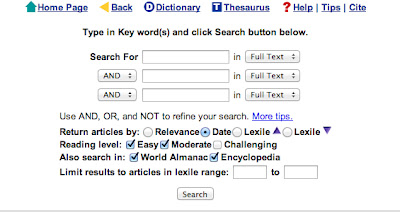
Remember to click on "advanced search".
Be sure to select "full text" in each of the drop down menus. Also select "date", "World Almanac" and "Encyclopedia". UNselect "challenging".
See below for a picture...
Friday, April 19, 2013
9.2 Converting "Easy" Fractions into Percents
I have $100 left in my classroom budget. I want to buy some treats for the class party. Ms. Graham says I can spend 1/2 of the money on drinks, 1/4 of the money on snacks and 1/10 on plates. I have to save the rest for books.
What PERCENT can be spent on snacks? How much money is that?
What PERCENT can be spent on drinks? How much money is that?
What PERCENT can be spent on plates? How much money is that?
What PERCENT do I have left? How much money is that?
Be sure to prove your thinking with a representation.
Part II
Oops, I made a mistake. I only have $40 left. Ms. Graham says I can spend 1/5 of the money on drinks, 1/4 of the money on snacks and 3/10 of the money on plates. I have to save the rest for books.
What PERCENT can be spent on snacks? How much money is that?
What PERCENT can be spent on drinks? How much money is that?
What PERCENT can be spent on plates? How much money is that?
Be sure to prove your thinking with a representation.
Part III
Silly Ms. Graham! She changed her mind AGAIN! Now she says I can spend 20% of the $40 on snacks, 30% of the $40 on drinks, and 35% on plates. How much can I spend on snacks? On drinks? On plates?
Be prepared to communicate your thinking with a representation.
Part IV
Drinks are $.25 each. Snacks are $.10 each. Plates are $.10 each. If we use the calculations from part II, how much money do I need for 22 students ? If I can only spend 1/5 of the money on drinks, 1/4 of the money on snacks and 3/10 of the money on plates, how much money will I need to pay out of my personal account? What if we wanted to share that cost equally between 22 kids and 1 teacher. Approximately, how much would each kid pay?
What PERCENT can be spent on snacks? How much money is that?
What PERCENT can be spent on drinks? How much money is that?
What PERCENT can be spent on plates? How much money is that?
What PERCENT do I have left? How much money is that?
Be sure to prove your thinking with a representation.
Part II
Oops, I made a mistake. I only have $40 left. Ms. Graham says I can spend 1/5 of the money on drinks, 1/4 of the money on snacks and 3/10 of the money on plates. I have to save the rest for books.
What PERCENT can be spent on snacks? How much money is that?
What PERCENT can be spent on drinks? How much money is that?
What PERCENT can be spent on plates? How much money is that?
Be sure to prove your thinking with a representation.
Part III
Silly Ms. Graham! She changed her mind AGAIN! Now she says I can spend 20% of the $40 on snacks, 30% of the $40 on drinks, and 35% on plates. How much can I spend on snacks? On drinks? On plates?
Be prepared to communicate your thinking with a representation.
Part IV
Drinks are $.25 each. Snacks are $.10 each. Plates are $.10 each. If we use the calculations from part II, how much money do I need for 22 students ? If I can only spend 1/5 of the money on drinks, 1/4 of the money on snacks and 3/10 of the money on plates, how much money will I need to pay out of my personal account? What if we wanted to share that cost equally between 22 kids and 1 teacher. Approximately, how much would each kid pay?
Thursday, April 18, 2013
Percent Problems
The fire department hopes to raise $30,000 to repair a fire house. So far the department has raised $1,750.00. What percent is this of their goal?
Monday, April 15, 2013

Friday, April 12, 2013
Sungei Buloh Field Trip-Thursday, April 18
Mrs. Gaskell’s Sungei Buloh Chaperone Sign Up
Dear families,
On Thursday, April 18 from 8:10-12:00, our class will visit the Sungei Buloh Wetlands Reserve. This is a terrific social studies/science field trip where students explore the uniquely adapted flora and fauna of the mangrove and wetland biome. For more information on the reserve, you can visit http://www.sbwr.org.sg/ Chaperones can meet at school by 8:10 to ride the bus or meet us at SBWR by 8:30. Chaperones will guide a small group at the nature reserve. If you would like to chaperone, please sign up below.
Below are the enduring understandings and essential questions to guide the field trip.
Enduring Understandings for students:
- Environments have unique features.
- People and environments are interdependent.
- There are different perspectives on environmental use.
- Certain environments are at risk and we have a civic responsibility to take care of them.
Essential Questions for our Sungei Buloh investigation:
- What makes a mangrove and wetland environment unique?
- How do people and environments depend on each other?
- Why do we care about mangrove and wetland habitats?
What to wear:
Precaution against mosquito bites (from the Sungei Buloh website): “SBWR is a nature reserve where mosquitoes naturally inhabit. To prepare for a visit to the wetland reserve, visitors should wear shoes and socks and apply insect repellent on exposed skin and clothing before entering the wetland reserve. The insect repellent can help to keep the mosquitoes away and make your visit to the wetland reserve a more enjoyable and safe outing.”
· Tennis shoes or good hiking shoes with socks (no sandals)
· A hat
· Sunscreen and insect repellent (please spray your child PRIOR to school – or send your preferred repellant in your child’s backpack)
· Sunglasses
· Bag lunch and a healthy snack (i.e. packed sandwich, a bag of crackers, fruit) Please, no fizzy drinks or soda.
· A bottle of water – it’s a lot of walking!
· A small, folding umbrella that can fit in a backpack. If there is rain, but no lightning, the field trip will still take place.
· Field glasses/binoculars (optional)
· A camera (optional)
Chaperone’s Name
|
Put an X under this box if you will meet us at Sungei Buloh Wetlands Reserve at 8:30.
|
Put an X under this box if you will come to school and ride the bus at 8:10.
|
Debra Surrency
|
X
| |
Benedicte Heaney
|
x
| |
Jody Havens
|
X
| |
Brian Koldyke
|
x
| |

Thursday, April 11, 2013
Trustworthiness-Finding Information in More Than One Place
1. Find 2 (or more) facts about whales in AT LEAST two out of the 3 articles. Highlight them in one color.
2. Record the notes in your Writer's Notebook. Tell which article you found the information in.
Example: Whales-marine animals. Found in What is a Whale? and Fun Whale Facts
3. Be prepared to share your trustworthy facts with the group. You can simply take a picture of the sections in the different articles.
4. Find an interesting fact about the whales that was only in one of the articles that you think would be worthwhile doing further research to see if you can find the information in another resource. Record it in your notebook.
2. Record the notes in your Writer's Notebook. Tell which article you found the information in.
Example: Whales-marine animals. Found in What is a Whale? and Fun Whale Facts
3. Be prepared to share your trustworthy facts with the group. You can simply take a picture of the sections in the different articles.
4. Find an interesting fact about the whales that was only in one of the articles that you think would be worthwhile doing further research to see if you can find the information in another resource. Record it in your notebook.
Subscribe to:
Posts (Atom)